
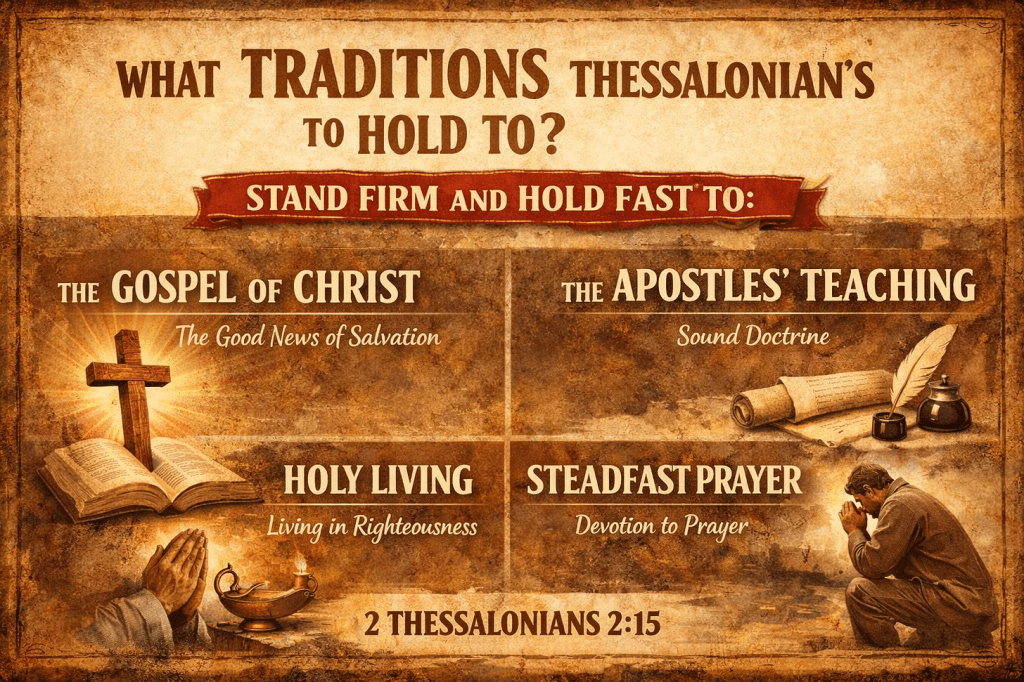
“So then, brothers, stand firm and hold to the traditions that you were taught by us, either by our spoken word or by our letter” (2Th 2:15)
Should Protestants accept that the apostles, like Paul, gave unwritten traditions that are equal to scripture, that we must stand firm and hold to? What are the traditions spoken of by Paul here?
In this passage, Paul tells the Thessalonians to stand firm and hold to the “traditions” that they were taught, either by our “spoken word” or by “our letter.”
This is the second letter Paul has written to the Thessalonians. Paul had instructed them about many things and clarified some misunderstandings, particularly some misunderstandings about the second coming of Christ and the need to live holy lives as they await the coming of Jesus.
He also explained how there was a time when he lived among them and taught them many things.
1Th 2:11 For you know how, like a father with his children, 1Th 2:12 we exhorted each one of you and encouraged you and charged you to walk in a manner worthy of God, who calls you into his own kingdom and glory.
This time, when Paul was among them, he taught them how to live and follow God. He especially taught them the Gospel of God that they received:
1Th 2:7 But we were gentle among you, like a nursing mother taking care of her own children. 1Th 2:8 So, being affectionately desirous of you, we were ready to share with you not only the gospel of God but also our own selves, because you had become very dear to us. 1Th 2:9 For you remember, brothers, our labour and toil: we worked night and day, that we might not be a burden to any of you, while we proclaimed to you the gospel of God.
He also taught them how to live godly lives, not being lazy as some in Thessalonica were doing. He taught them about the second coming of Christ and the coming of the “lawless one. As he says here:
2Th 2:5 Do you not remember that when I was still with you I told you these things?
So from this we can conclude that Paul stayed with them, taught them about the Gospel of God, and how to live godly lives by setting a good example. especially setting an example of working hard, and he taught them about the second coming of Christ, including some teaching about the coming of the lawless one.
This is what we know he taught them, as he says so in his letter. Did Paul teach them the Marian dogmas? Did he teach them about the pope? Or the magistirium? Or the many traditions that are claimed today as “apostolic tradition” that Catholics and Orthodox use 2 Thess 2:15 as a proof text for?
Firstly, the text is silent about this, and so a positive argument cannot be made from this text. Do we have any reason to believe Paul did teach such things when he was with them? No, why? Because the traditions Paul is speaking about here in context are particularly about what he has already indicated he taught them and reminded them about in the letter, the Gospel of God, not to be lazy but work (see 2 Thess 3:6), and in the immediate context, the teaching about the second coming of Christ.
Let’s consider the context of 2 Thess 2:15. There were some in Thessalonica who were shaken by thinking the “day of the Lord had already come.”
2Th 2:2 not to be quickly shaken in mind or alarmed, either by a spirit or a spoken word, or a letter seeming to be from us, to the effect that the day of the Lord has come.
Paul begins to explain to them that the day of the Lord will not come until the “rebellion comes first”
2Th 2:3 Let no one deceive you in any way. For that day will not come, unless the rebellion comes first, and the man of lawlessness is revealed, the son of destruction,
Paul is reassuring them that the day of the Lord had not yet come because the rebellion and the arrival of the man of lawlessness had not yet come. Paul had taught them about this already
2Th 2:5 Do you not remember that when I was still with you I told you these things?
Paul goes on to explain that when the lawless one comes, he will bring with him great deception and that they should not be deceived by what he calls “false signs and wonders” (2 Thess 2:9). That they should not be shaken by “a spoken word of a letter” that teaches the day of the Lord has already come.
He assures them that God has “chosen them to be saved” (2 Thess 2:13), that God has “called them by his Gospel to obtain the glory of the Lord” (2 Thess 2:14). Since this is so, since the day of the Lord is still future, since such a deception is coming, they need not be shaken and stand firm, holding to the “tradtions” which are that which he has taught them in this letter and what he told them when he was “still with them” that is “by letter or spoken word.”
We can see, therefore, that the traditions spoken of by Paul, which are by “spoken word and by letter,” relate specifically to the second coming of Christ, not some other later traditions like the Marian dogmas, the teachings of the magisterium and the pope and so on.
The “traditions” spoken of here are spoken of in the letter; Paul did not teach some things by the letter and then different things by word. Rather, Paul is saying I taught you in person when I was there, and I am again teaching you by letter, stand firm in these things and do not be shaken as if the day of the Lord has already come.
In conclusion, this verse cannot be used as permission to include any later non-scripturally based traditions.

